
The first ready meal of the week arrives with an explanation. It is late, there is little in the fridge, and the alternative involves effort that the day has already spent. The second ready meal arrives with less explanation. The fifth, in a different week, requires none.
How Convenience Food Patterns Become Default
Ready meal reliance is rarely a decision that is consciously made. The pattern settles in through a sequence of small capitulations, each reasonable in isolation, that together alter the structure of how a household eats. Within a few weeks, the default has shifted. Home cooking has become the exception that requires planning, while the convenience option has become the baseline that requires nothing.
The nutritional implications of this shift have been examined extensively in published research on the UK diet. Ultra-processed ready meals — a category that encompasses most supermarket options — tend to share a specific profile: elevated sodium, added refined carbohydrates, a higher energy density relative to volume, and a reduced fibre content compared to equivalent home-prepared meals. These are not uniformly large differences, but they are consistent ones, and they compound across a week's eating.
Convenience food patterns also tend to reduce dietary variety in ways that are not immediately perceptible. The ready meal range that a household rotates through is typically narrow — four or five products selected for reliability and speed. Over time, this narrows the range of ingredients entering the weekly diet, which matters both for overall nutritional breadth and for the social dimension of cooking that shared meals in a home ordinarily carry.
High-Salt Food Habits and Ready Meal Consumption
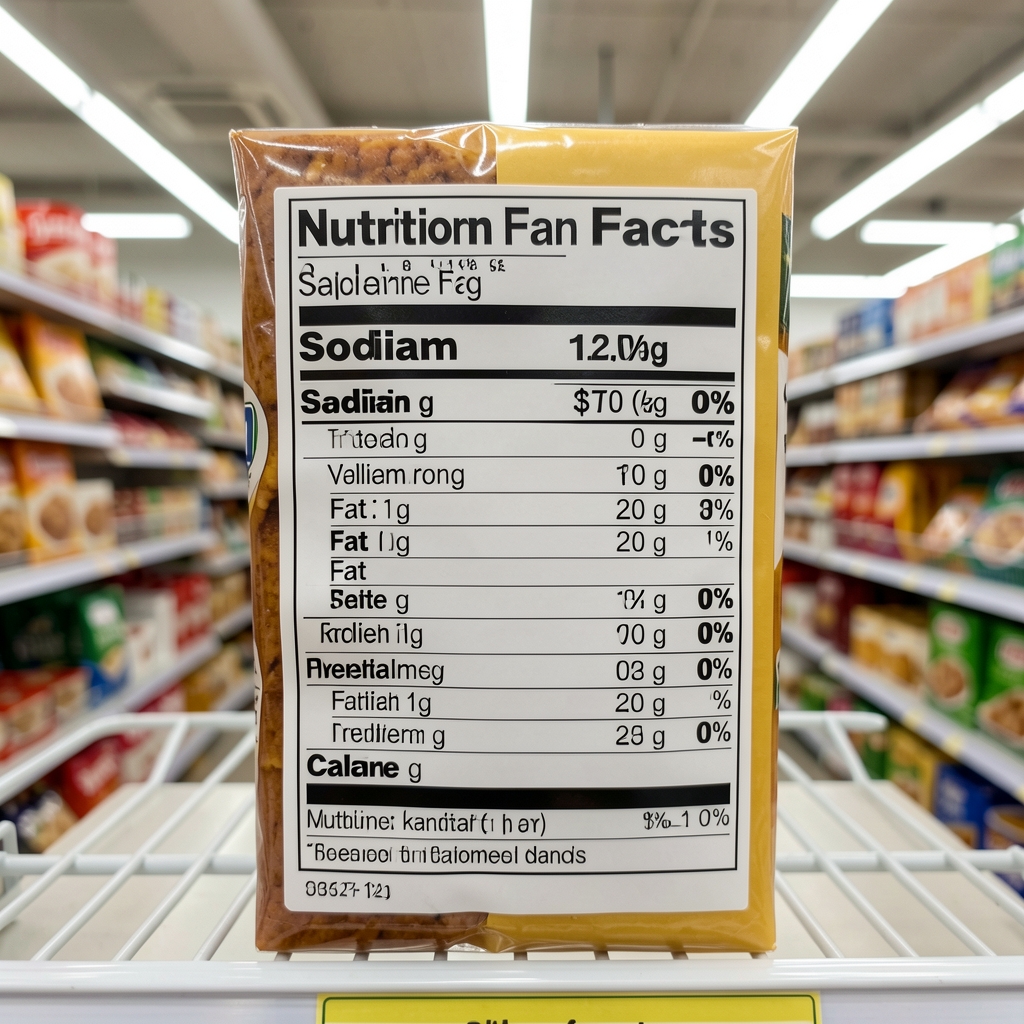
Among the more consistent findings associated with ready meal reliance is elevated dietary sodium intake. High-salt food habits are well documented in the UK context, where sodium levels in commercially prepared meals consistently exceed those of equivalent home-prepared dishes. The reasons are structural: salt is an effective flavour carrier and preservative, and its presence in manufactured foods has historically been calibrated to taste expectations rather than nutritional recommendations.
For a household consuming three or more ready meals per week, the sodium contribution from these meals alone can approach or exceed recommended daily intake levels, leaving little room for the sodium that arrives in bread, stock, sauces, and condiments used for any home-prepared meals in the same period. This does not produce immediate visible consequences, which is part of why high-salt food habits are slow to be identified as a concern without deliberate tracking.
The relationship between ready meal frequency and high-salt food habits is not a reason to regard all ready meals as incompatible with a reasonable diet. It is an argument for regarding frequency as a variable worth examining, and for choosing products where labels are read rather than assumed.
Refined Carbohydrates and Weight: The Ready Meal Contribution
Refined carbohydrates and weight are linked through a well-examined mechanism: rapidly absorbed carbohydrates produce a faster post-meal energy peak followed by a more pronounced trough, which is associated with earlier return of appetite and a tendency toward higher subsequent intake. Ready meals whose primary carbohydrate component is white rice, white pasta, or refined bread — the most common starch bases in the UK ready meal market — sit firmly in the rapidly absorbed category.
This is not an argument that refined carbohydrates are the cause of weight change in any direct or simple sense. The relationship is contextual, mediated by overall diet composition, fibre intake, eating patterns across the day, and individual variation. What the research consistently shows is that high-frequency consumption of refined carbohydrate-heavy convenience food — several times per week, across months — tends to accompany weight increase in population-level studies, and that cooking at home benefits include a natural reduction in refined carbohydrate density because home-prepared meals more often include fibrous vegetables and less-processed grains.
The cooking at home benefits documented in the research are cumulative rather than dramatic: a modestly wider variety of ingredients, a lower typical sodium level, a higher average fibre content, and a reduced average energy density. None of these differences is transformative meal-by-meal, but the cumulative impact across a year's eating is substantial.
Restoring the Cooking Rhythm Without Dramatic Change
The research on gradual dietary improvement suggests that changes which require a wholesale restructuring of behaviour tend not to persist. A household that has built its week around ready meals will not reliably shift to daily home cooking through willpower alone; the friction reduction that originally enabled the reliance is still there.
What the evidence supports instead is a habit-based approach: the substitution of one or two ready meal occasions per week with a simple home-prepared alternative, held consistently across several weeks, tends to produce a durable shift in the default. This is not a directive but an observation from the published literature on habit-based eating and behaviour change. The cooking at home benefits accumulate not from occasional heroic efforts but from steady, low-resistance practice.
Articles published on Elano Quarterly are editorial in nature and reflect the writers' observations on everyday wellness practices. The content is not intended as professional advice, nor as guidance for the management of any specific condition. Readers with specific concerns about their daily routines are encouraged to speak with a qualified wellness professional.
- 01 Ready meal reliance develops incrementally, through a series of individually reasonable decisions that collectively shift the household default.
- 02 Consistent ready meal use is associated with elevated sodium intake, reduced dietary variety, and higher refined carbohydrate density compared to home-prepared equivalents.
- 03 Cooking at home benefits — lower sodium, more fibre, greater ingredient variety — accumulate gradually rather than appearing meal-by-meal.
- 04 Gradual dietary improvement through modest, consistent substitution is more reliably durable than wholesale behavioural restructuring.